
O-Ring Code Cracked26 Years Marzocchi87 O-Rings
Fox ended the support, the parts lists vanished. With AI data processing and a cross-check of five sources - Marzocchi parts lists, an old 2018 tech.marzocchi data package, a stock list and more - 1,016 fork + year combinations came down to only 87 different O-rings: standard industrial sizes, as far as we can see all NBR 70.
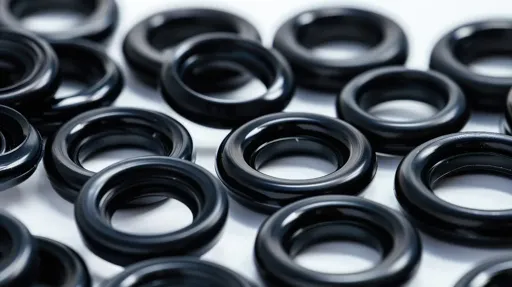
Every Marzocchi fork is held together by a handful of small black rubber rings. Nobody looks at them — until a top cap weeps oil, an air fork loses pressure overnight or a damper suddenly has no rebound left. Then the question is always the same: which O-ring is it, and where do I get it?
For years there was no good answer. This article is about how we found one — and why the result surprised even me: 26 years of Marzocchi forks run on only 87 different O-rings.
Why O-rings matter so much
An O-ring is the cheapest part in a fork and one of the most important. It is a static seal: it sits in a groove and keeps oil in and air in, where two parts meet that do not move against each other.
- Top caps — the ring under the cap keeps the oil in the leg and, on air forks, the pressure in the air chamber.
- Dampers and cartridges — rings on pistons, rods and adjusters separate the oil circuits. A tired ring here means damping that fades or does not react to the knob any more.
- Adjusters and valves — compression and rebound knobs, lock-outs, air valves: every one of them seals with an O-ring.
- Foot nuts — the ring on the foot nut keeps the oil bath in the lower leg.
Rubber ages. After ten or twenty years an O-ring gets hard, flattens in its groove (compression set) and stops pushing back. The fork does not fail in one day — it slowly leaks, loses air or loses damping. A new ring costs cents. Using the wrong one costs a lot more: one size too small and it is overstretched and cut at assembly, one size too big and it folds and leaks. The cross-section must be exactly right, otherwise the groove does not seal at all.
The problem: the support is gone
Fox took over Marzocchi's bike business in 2015. Despite all promises, in the third quarter of 2021 Fox abruptly ended the support and shipping spare parts for Marzocchi forks of model year 2018 and older. Parts lists, service documents and the old service site tech.marzocchi are no longer online, and spare parts for forks from the 1990s and 2000s are not sold any more. Thousands of riders still ride these forks — and they are on their own.
The information was never in one place anyway. Marzocchi listed O-rings by their own article numbers (528030, 528152 …), and the size was only written in the Italian part name — if at all. Many parts lists just say "O-RING".
An article number without a size is useless outside Marzocchi. A size without the fork it belongs to is useless for the rider. We needed both — for every fork and every year.
The sources — and the cross-check
No single source had the full picture. So we put five of them side by side and compared every number against each other:
- The original Marzocchi parts lists 1990 – 2007 — our archive of more than 500 parts lists: article number, quantity per fork and the position in the exploded drawing. These lead: a number from a parts list wins over every other source.
- An old 2018 tech.marzocchi data package — some data from the Marzocchi service site, saved before it went offline: the article numbers per fork for the years 2008 – 2018, and Marzocchi's own part names, often with the size.
- The document texts — the text of the parts-list PDFs, where the Italian line carries the size: "OR 2050 (D12.4 S1.78)".
- A former distributor's stock list — used only to check: 39 of its sizes agree with ours, none differs. It filled in the sizes that the other sources lacked.
- Manual edits — from measuring original parts, notes from bike shops and more.
AI as the data workhorse
This is the kind of work that used to take months by hand: reading hundreds of documents line by line, matching numbers, spotting typos. Here AI did the heavy lifting — AI-written scripts read the document texts, matched every article number to its forks and sorted out the contradictions. I checked the results and decided every case the data could not settle. The machine is fast; the knowledge of what a Marzocchi part is still has to come from the bench.
Normalizing — making the data comparable
Raw data from 26 years and five sources does not fit together by itself. These were the steps:
- One article number — "528030", "528030.0" and "528030/A" are the same part: every number is cut to its 6 – 7 digit base number.
- One way to write a size — "D12.4 S1.78", "(12,0X1,0)", "D.4,0 S.1,0", "28.00X3.00": every spelling becomes inner diameter × cross-section in mm, with a decimal point (12.4 × 1.78).
- Clean text — the PDF texts use special Unicode hyphens; they become plain hyphens, so "6‑613" and "6-613" match.
- One spelling of the rubber — "Nbr70", "nbr 70", "NBR 70" → NBR70.
- Is it really an O-ring? — "ANELLO" is Italian for ring, not every ring is rubber: "ANELLO D.27,5X1,5 C72" is a steel ring. Parts that only carry an O-ring ("Plug + O-ring") are listed apart.
- Same size = same ring — two article numbers with the same size are the same O-ring for the rider. Only two sizes show up under two numbers each: 9.0 × 1.0 and 26.7 × 1.78.
- Doubts stay visible — four numbers where the sources contradict each other are marked "please check" instead of being guessed.
The breakthrough: 87 O-rings
The result, after the cross-check:
- 1,016 fork + year combinations (785 fork models, 1993 – 2018)
- 3,290 fork-to-O-ring links — 1,833 from the parts lists, 1,457 from tech.marzocchi 2018
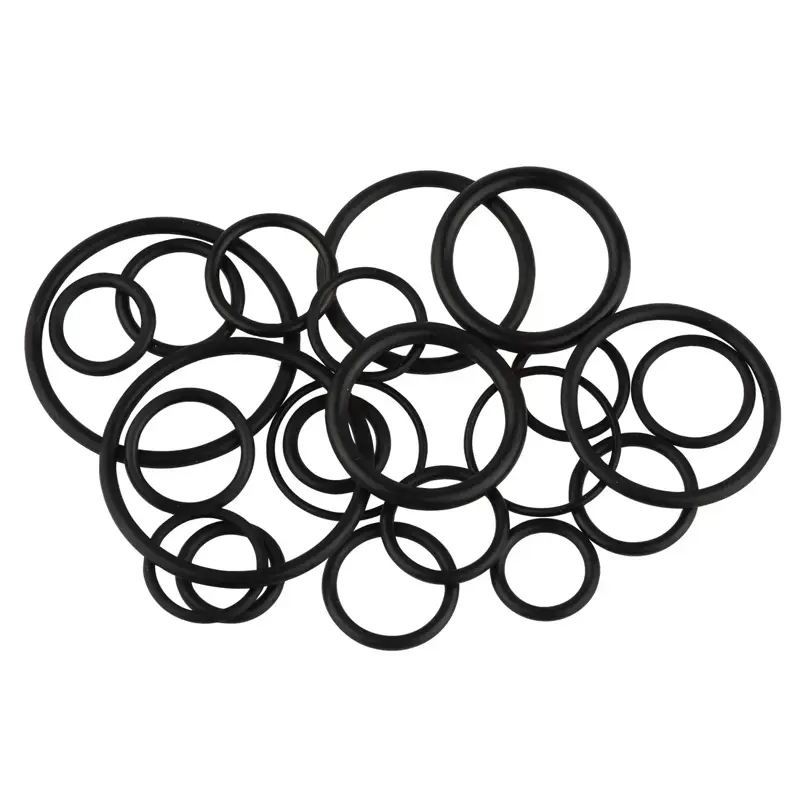
- 87 different O-ring article numbers — 71 different sizes known
Hundreds of fork models, one O-ring family. Marzocchi used the same rings again and again, across models and across decades. 25.1 × 1.78 for example appears from 1997 until 2018. That is good news: with a few well-chosen kits, almost every Marzocchi fork can be brought back to life.
Standard industrial O-rings — Marzocchi's names decoded
The second discovery: these are not secret Marzocchi parts. Behind the article numbers are standard industrial O-rings, and the Italian part names carry the standard designations. Marzocchi was an Italian company in the EU and worked in the DIN / ISO world — so it used standard DIN / ISO O-rings (ISO 3601 also covers the classic inch sizes with 1.78 and 2.62 mm cross-section):
| Marzocchi name | Size (mm) | What it means |
|---|---|---|
| OR 2081 (D20.3 S1.78) | 20.3 × 1.78 | OR code 2081, D = inner diameter, S = cross-section. Codes 2xxx are always 1.78 mm thick |
| OR 3075 (D18.7 S2.62) | 18.7 × 2.62 | Codes 3xxx are always 2.62 mm thick |
| OR 6-613-N674-70 (D.4,0 S.1,0) | 4.0 × 1.0 | Parker size 6-613, compound N674-70 = NBR, 70 Shore A |
| OR 6-581(6.5X1.5) NBR70 | 6.5 × 1.5 | Parker size, material written out: NBR 70 |
| O RING (P22) FAA072 | 21.8 × 2.4 | Japanese standard size P22 (JIS B 2401) plus a supplier code |
| OR 28.00X3.00 | 28.0 × 3.0 | The later style (tech.marzocchi 2018): plain metric size |
The two most common cross-sections, 1.78 mm and 2.62 mm, are the classic inch-based O-ring series (0.070" and 0.103") — about half of all known sizes. The rest are metric rings with 1.0, 1.5, 2.0 or 3.0 mm cross-section, mostly inside the dampers.
The material: NBR 70
Wherever Marzocchi wrote the material into the name, it is almost always the same: NBR 70 — nitrile rubber with a hardness of 70 Shore A (Parker compound N674-70). Of 13 names that state a compound, 11 say NBR 70, one more says 70 Shore with another compound code, and only one is harder: an NBR 90 ring (N552-90) in a high-pressure spot.
As far as we can see, the O-rings in Marzocchi forks are standard NBR 70. That makes sense: NBR is the standard material for mineral fork oil — oil-resistant, elastic, cheap. It also means that a good-quality NBR 70 ring in the right size is the right replacement.
The right size and the right cross-section matter more than the brand. A 1.78 ring in a 2.62 groove will never seal — no matter how good the rubber is.
Never reuse an old O-ring when the fork is open. It has taken the shape of its groove and will not seal again.
What you can do with it now
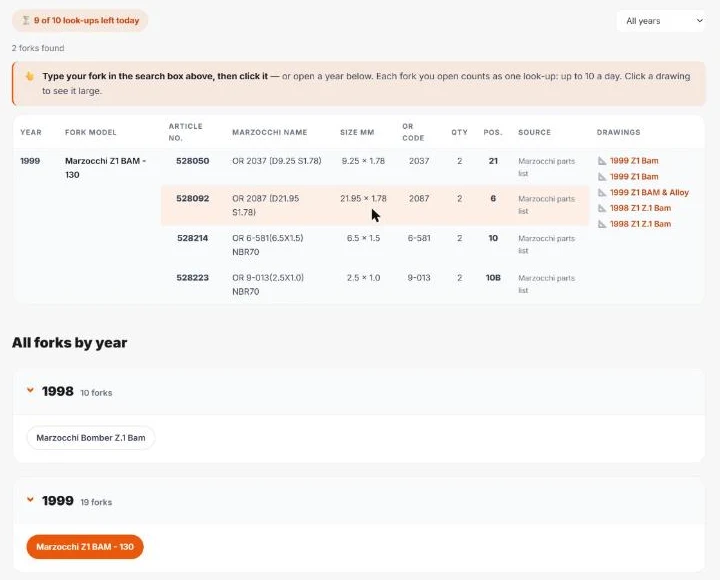
- O-Ring Finder — type your fork and year, click it, and you get its O-rings with size, OR code, quantity, position and the exploded drawing.
- All O-rings Marzocchi used — every ring once, with its size and code.
- O-ring service kits — the next step: kits per fork family and stanchion size, so you do not have to hunt for single rings. They are in the making.
Twenty-six years of Marzocchi forks, 87 O-rings.
The forks were built to last — now the parts to keep them running are known again.
Summary
87 O-rings found, 71 sizes known, 1,016 forks linked — a big step. But it is still a lot of work: sizes are missing, documents are missing, and some numbers still contradict each other. Even AI cannot change what companies try to hide from this community and true Marzocchi fork owners.
Hopefully we will get some proper data — every measured ring and every old document closes another gap.
If you like to help, please get in contact — we like it all: original parts lists, CDs / DVDs, service documents, measured O-rings, pictures, ads, posters etc. All the old stuff which makes us happy!
Our focus is only on the older data.
We will reward good data!